
What Is a Cyberattack and How Hackers Actually Choose Their Targets

By Kate Willis on May 17, 2026
Cyberattacks often sound like something pulled straight from a Hollywood movie, mysterious hackers typing furiously in dark rooms while giant corporations panic behind the scenes. But the reality is usually far less dramatic and far more common than most people realize.
Today, cyberattacks affect almost everyone. Businesses, hospitals, schools, governments, and ordinary individuals all face growing digital threats. In many cases, hackers are not targeting people because they are important. They are targeting them because they are vulnerable.
Understanding how cyberattacks work and how attackers choose their victims makes modern cybersecurity feel much less mysterious and much more human.
Key Takeaways
- Cyberattacks are attempts to steal, damage, or manipulate digital systems
- Hackers usually target weaknesses, not specific individuals
- Phishing remains one of the most common attack methods
- Small businesses and regular users are often easier targets than large corporations
- Human behavior is frequently the biggest cybersecurity vulnerability
What a Cyberattack Actually Is
A cyberattack is any attempt to gain unauthorized access to digital systems, devices, or networks.
Sometimes the goal is financial. Attackers may steal banking information, lock files for ransom, or scam victims into transferring money. Other times, the goal is disruption, espionage, or data theft.
Cyberattacks can take many forms, including:
- Phishing emails
- Malware infections
- Ransomware attacks
- Password breaches
- Data leaks
- Identity theft
- Website attacks
- Social engineering scams
Not every attack involves advanced coding skills. In fact, many successful cyberattacks rely more on psychology than technology.
Hackers often target human mistakes because people are usually easier to manipulate than software.
Hackers Rarely “Hack Randomly”
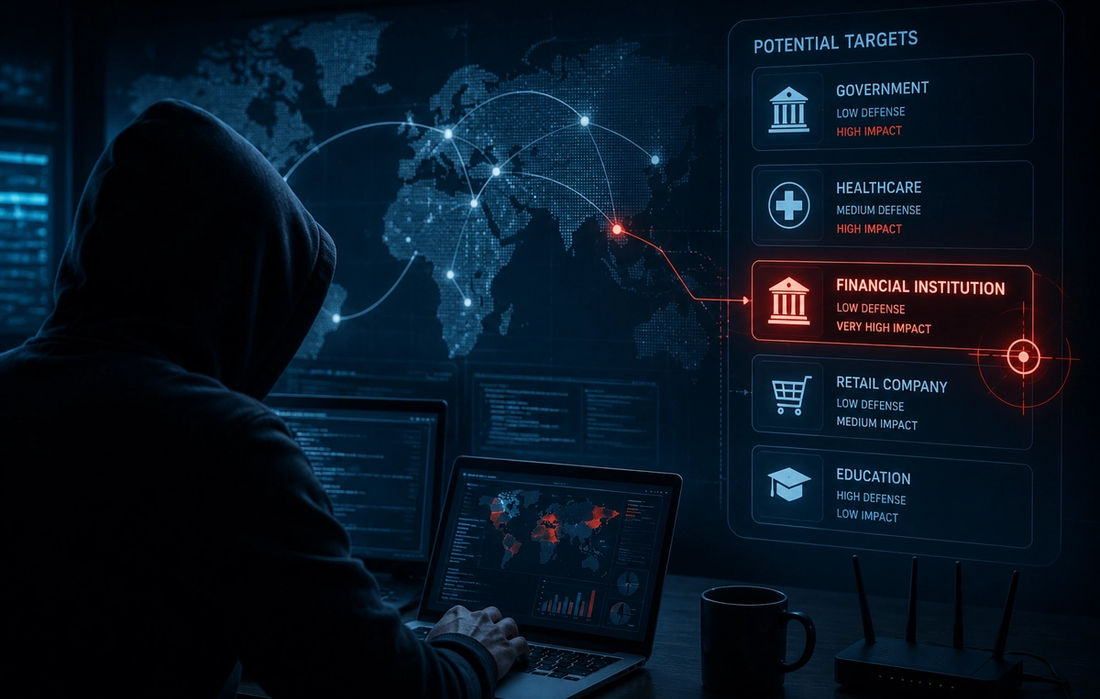
One of the biggest misconceptions about cybercrime is that hackers randomly choose victims.
In reality, most attackers look for the easiest possible opportunities.
Hackers often scan the internet for:
- Weak passwords
- Outdated software
- Unsecured networks
- Exposed databases
- Employees likely to click suspicious links
Small businesses are especially common targets because they typically have weaker cybersecurity protections than major corporations.
Many attacks are automated. Criminal groups use software that constantly searches for vulnerable systems across the internet. If a weakness is found, the attack may happen within minutes.
To a hacker, vulnerability matters far more than fame or importance.
Phishing Attacks Are Still Extremely Effective
Despite growing awareness around cybersecurity, phishing remains one of the most successful attack methods in the world.
Phishing happens when attackers impersonate trusted companies, coworkers, or services to trick people into revealing sensitive information.
A phishing message may claim:
- Your account was compromised
- A package could not be delivered
- Your password needs resetting
- A payment failed
- An urgent invoice requires attention
The goal is usually to create panic, urgency, or curiosity.
Modern phishing attacks have become surprisingly convincing. Some fake emails and websites look nearly identical to legitimate ones. Attackers also increasingly use text messages, phone calls, and social media platforms.
Even experienced users can occasionally fall for sophisticated scams when distracted or rushed.
Ransomware Became a Massive Criminal Business
One of the fastest-growing forms of cybercrime is ransomware.
In a ransomware attack, hackers lock or encrypt files so victims cannot access them. The attackers then demand payment — often in cryptocurrency — in exchange for restoring access.
Hospitals, schools, businesses, and city governments have all been affected by ransomware attacks in recent years.
The reason ransomware became so common is simple: it works.
Organizations often feel pressured to pay because losing access to critical systems can become incredibly expensive. Some businesses cannot function at all during prolonged outages.
Cybercriminal groups now operate almost like real companies, complete with customer support systems, profit-sharing structures, and organized attack networks.
Human Error Is Often the Biggest Weakness
Many people imagine cyberattacks breaking through highly advanced security systems using complex code. But in reality, human behavior is frequently the easiest entry point.
Simple mistakes cause enormous cybersecurity problems:
- Reusing passwords
- Clicking suspicious links
- Ignoring software updates
- Using unsecured Wi-Fi networks
- Sharing too much information online
Hackers understand that people become distracted, tired, rushed, or careless.
That is why social engineering — manipulating human behavior — has become one of the most effective attack strategies. Attackers study how people think and react emotionally, then design scams around those reactions.
Sometimes a convincing email is far more powerful than sophisticated hacking tools.
Governments and Corporations Face Different Threats
Not all cyberattacks are motivated by money.
Some attacks are politically motivated or tied to espionage. Governments may target rival nations, infrastructure systems, communication networks, or military organizations.
Large corporations also face attacks aimed at stealing intellectual property, customer data, or trade secrets.
Meanwhile, ordinary users are more commonly targeted through:
- Financial scams
- Identity theft
- Credential leaks
- Social media account takeovers
- Fake shopping websites
The methods may differ, but the core principle stays the same: attackers search for vulnerabilities that offer the highest reward with the lowest resistance.
Why Cybersecurity Feels More Important Than Ever
Modern life depends heavily on digital systems. Banking, communication, healthcare, shopping, entertainment, and work all rely on connected technology.
That dependence creates more opportunities for attackers.
At the same time, cybercrime has become easier to organize. Some malicious software can now be purchased or rented online, lowering the barrier for inexperienced criminals.
Artificial intelligence is also changing cybersecurity rapidly. AI tools can help detect threats faster, but attackers are also beginning to use AI to create more convincing scams and automate attacks.
The digital world is becoming more sophisticated on both sides.
Basic Cybersecurity Habits Matter More Than Most People Think
The good news is that many cyberattacks can still be prevented through simple habits.
Strong passwords, two-factor authentication, software updates, and cautious behavior online remain extremely effective defenses.
People often assume cybersecurity requires advanced technical knowledge, but awareness alone prevents many common attacks.
The reality is that hackers usually do not need to break through impossible defenses. They simply look for easy opportunities and human mistakes.
In a world where more of life happens online every year, basic digital hygiene has become just as important as locking your front door or protecting your wallet.
Cybersecurity is no longer only a concern for tech experts — it has quietly become part of everyday life for everyone connected to the internet.