
The Wild History of Speedrunning (And Why It’s a Sport Now)

By Kate Willis on May 18, 2026
Most people try to finish video games. Speedrunners try to break them.
Speedrunning is the art of completing games as fast as humanly possible, often using strategies, shortcuts, glitches, and levels of precision that seem almost impossible to casual players.
What started as a niche internet hobby slowly evolved into a global competitive scene with tournaments, livestreams, massive audiences, and players dedicating years to shaving seconds off world records.
Today, speedrunning is widely treated like a legitimate competitive sport — even though, at its core, it is still people obsessively trying to beat video games faster than anyone else on Earth.
Key Takeaways
- Speedrunning began as a small internet gaming community
- Players use advanced strategies and glitches to finish games rapidly
- Entire communities form around mastering specific games
- Livestreaming helped turn speedrunning into mainstream entertainment
- The scene now resembles professional competition in many ways
Speedrunning Started Long Before Twitch
Speedrunning existed even before modern streaming platforms.
In the 1990s, players of games like Doom and Quake competed to complete levels as quickly as possible while recording gameplay demos to share online.
Early internet forums and fan communities became places where players exchanged:
- routes
- shortcuts
- glitches
- timing strategies
The goal was simple: find the absolute fastest way to beat the game.
At first, speedrunning felt extremely niche. Most casual players barely understood why someone would spend hundreds of hours trying to save a few seconds in a game they already finished years ago.
Glitches Became Part of the Art Form
One of the most fascinating parts of speedrunning is how deeply players study game mechanics.
Speedrunners often discover bizarre techniques developers never intended:
- clipping through walls
- skipping levels
- manipulating physics
- exploiting enemy behavior
- breaking scripted events
Some glitches are so strange they completely transform how a game functions.
To outsiders, speedruns can look chaotic or confusing because players often ignore normal gameplay entirely in favor of highly optimized movement and exploits.
In many ways, speedrunners treat games less like entertainment and more like systems to be solved.
Entire Communities Formed Around Single Games
One thing that makes speedrunning unique is how dedicated communities become around specific games.
Some runners spend years mastering only one title.
Games like:
- Super Mario 64
- The Legend of Zelda: Ocarina of Time
- Minecraft
- Dark Souls
- Celeste
developed enormous speedrunning cultures with constantly evolving strategies and intense competition.
Communities document every discovery carefully, often collaborating to improve records collectively even while competing against each other.
The scene became surprisingly supportive despite its competitive nature.
Twitch and YouTube Changed Everything
Streaming platforms helped transform speedrunning from niche hobby into major internet entertainment.
Watching a skilled speedrunner can feel incredible because viewers witness:
- insane precision
- deep game knowledge
- high-pressure decision making
- near-perfect execution
Livestreams also made speedrunning feel more personal. Audiences watch runners practice repeatedly for hours or even months chasing tiny improvements.
The emotional payoff becomes huge when someone finally breaks a world record live in front of thousands of viewers.
Suddenly, speedrunning stopped feeling obscure and started feeling genuinely exciting to watch.
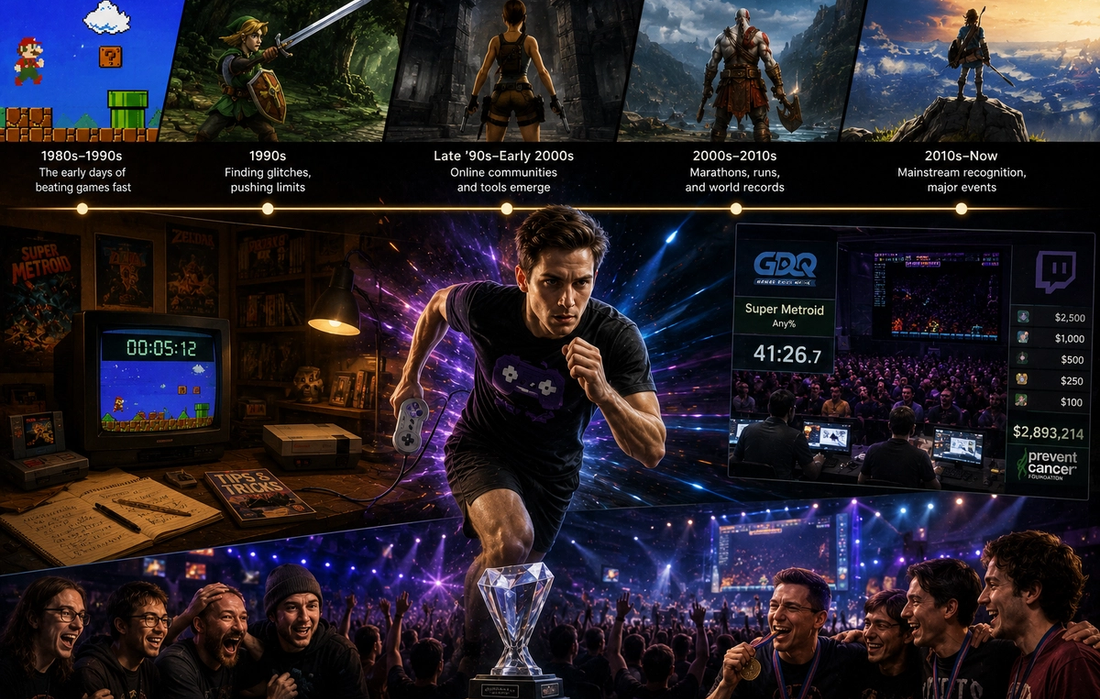
Games Done Quick Made Speedrunning Mainstream
One major turning point came through events like Games Done Quick.
These charity marathons gather speedrunners from around the world to complete games live while raising money for causes like cancer research and humanitarian aid.
The events became enormously popular because they combined:
- skill
- humor
- gaming nostalgia
- community energy
- live competition
Millions of dollars have been raised through speedrunning charity events over the years.
For many people, these marathons became their first introduction to speedrunning culture.
Speedrunning Requires Real Athletic Skill
Although it happens digitally, speedrunning shares many qualities with traditional sports.
Top runners train extensively:
- memorizing routes
- practicing timing
- optimizing movement
- improving reflexes
- handling pressure
Some runs require near-perfect execution for long periods without mistakes.
A single missed jump or incorrect input can ruin hours of attempts instantly.
The mental discipline involved often surprises people unfamiliar with the scene.
RNG Makes Some Records Almost Impossible
Another unique aspect of speedrunning is randomness.
Many games include random elements called RNG (random number generation), which means even perfect gameplay sometimes depends partly on luck.
This creates intense emotional moments where players may perform flawlessly only to lose time because of random enemy behavior or item drops.
In some games, world records require both extraordinary skill and extremely favorable luck simultaneously.
That unpredictability keeps competition alive constantly.
Speedrunning Changed How People View Games
Speedrunners often reveal things about games even developers never realized.
By pushing systems to their limits, runners expose hidden mechanics, unused code, strange physics interactions, and unexpected design flaws.
Some developers now actively support speedrunning communities because they appreciate the creativity and passion involved.
Certain modern games even include built-in timers or modes specifically designed for speedrunners.
The Scene Keeps Growing
Today, speedrunning has evolved into a full competitive ecosystem with:
- leaderboards
- tournaments
- livestream audiences
- sponsorships
- content creators
- dedicated communities
And yet, the culture still retains much of its original internet spirit: people obsessively exploring games simply because they love mastering them.
Speedrunning Is About More Than Going Fast
At its core, speedrunning is not really just about speed.
It is about curiosity, creativity, obsession, and human persistence. Players dedicate enormous amounts of time chasing improvements so tiny most people would never even notice them.
That dedication is what makes speedrunning fascinating.
Because while video games are designed to entertain, speedrunners transform them into something else entirely: a constantly evolving challenge between human skill and the limits of the game itself.