
5 Forgotten Game Boy Accessories That Were Actually Genius

By Kate Willis on May 17, 2026
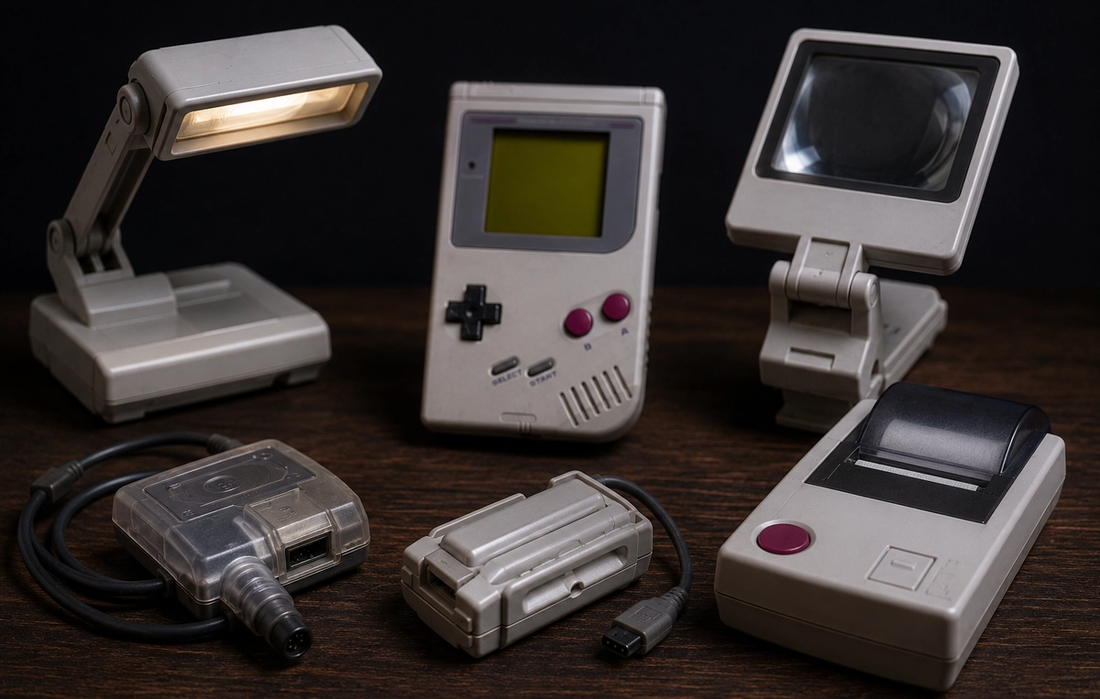
The original Game Boy was already revolutionary on its own. It allowed people to carry video games anywhere long before smartphones existed. But part of what made Nintendo’s handheld era so memorable was the bizarre ecosystem of accessories built around it.
Some of these gadgets were ridiculous. Others were surprisingly creative. And a few were genuinely ahead of their time.
While many Game Boy accessories faded into obscurity, some solved real problems or introduced ideas that modern gaming devices still use today.
Key Takeaways
- The Game Boy inspired a huge range of creative accessories
- Some forgotten gadgets solved real handheld gaming problems
- Nintendo experimented heavily with portability and social gaming
- Several Game Boy accessories were surprisingly innovative for their time
- Many ideas from older accessories influenced modern gaming hardware
1. The Game Boy Camera
The Game Boy Camera sounded absurd when it launched in 1998.
A tiny digital camera attached to a handheld gaming console seemed unnecessary at first, especially because the image quality was extremely low-resolution even by 1990s standards.
But the accessory quietly introduced ideas that became normal years later.
Users could:
- Take selfies
- Edit photos
- Create simple animations
- Add stamps and effects
- Print pictures using the Game Boy Printer
Long before smartphone cameras dominated everyday life, Nintendo was experimenting with portable digital photography in a playful way.
The Game Boy Camera now feels strangely futuristic in retrospect.
2. The Worm Light
Anyone who owned a Game Boy before backlit screens remembers one major problem: visibility.
Playing in the dark was nearly impossible without external lighting. The solution became one of the most iconic accessories of the era — the Worm Light.
This tiny flexible lamp plugged directly into the Game Boy and bent over the screen like a miniature desk light.
It looked simple, but it completely changed portable gaming during nighttime car rides, sleepovers, or dimly lit rooms.
For many players, the Worm Light felt almost essential rather than optional.
3. The Game Link Cable
The Game Link Cable quietly changed multiplayer gaming forever.
At a time when online gaming barely existed, the cable allowed two Game Boys to connect directly for local multiplayer matches.
Games like Pokémon made the accessory legendary because players could:
- Trade Pokémon
- Battle friends
- Unlock exclusive content
The social experience became just as important as the games themselves.
In many ways, the Link Cable helped establish portable multiplayer gaming culture years before Wi-Fi and online matchmaking became standard.
4. The Super Game Boy
Released for the Super Nintendo Entertainment System, the Super Game Boy allowed players to insert Game Boy cartridges directly into their home console and play handheld games on a television.
At the time, this felt incredibly advanced.
The accessory added:
- Color palettes
- Custom borders
- Larger screen support
- Enhanced sound features for some games
It blurred the line between handheld and home gaming long before devices like the Nintendo Switch existed.
Nintendo was already experimenting with hybrid gaming concepts decades earlier.
5. The Game Boy Pocket Sonar
Few Game Boy accessories were stranger than the Pocket Sonar.
Designed primarily for fishing enthusiasts, the device used sonar technology to help locate fish underwater. It connected directly to the Game Boy and displayed underwater activity on the screen.
The idea sounded bizarre for a gaming handheld, but it genuinely worked.
It also showed how experimental Nintendo became during the Game Boy era. The company was willing to transform its handheld into something beyond just a gaming device.
Very few companies today would release something this weird and specific.
The Game Boy Era Was Full of Experimentation
One reason these accessories remain fascinating is because they reflect a very different era of technology.
Modern gadgets often feel highly optimized and predictable. During the 1990s, tech companies experimented much more openly with strange ideas, even if some of them failed commercially.
The Game Boy became a platform for creativity:
- Cameras
- Printers
- Multiplayer cables
- Lights
- Scanners
- Fishing tools
Not every accessory succeeded, but many introduced concepts that later became surprisingly normal.
Nostalgia Makes These Gadgets Feel Special
Part of the charm comes from how physical these accessories felt.
Players carried cables, batteries, lights, and cartridges everywhere. Gaming involved tangible objects rather than instant digital downloads and cloud syncing.
That physical experience created memories modern gaming sometimes lacks.
Even awkward accessories now feel nostalgic because they represented a time when portable gaming still felt experimental and magical.
Some Forgotten Ideas Were Ahead of Their Time
Looking back, many of these accessories predicted future trends surprisingly well.
Portable photography, hybrid gaming, multiplayer connectivity, and mobile personalization all became massive parts of modern technology years later.
The Game Boy era may look primitive today, but many of its strange accessories contained ideas far more forward-thinking than people realized at the time.
And perhaps that is why gamers still remember them so fondly decades later.