
The Real Reason Time Feels Slower When You’re Bored

By Kate Willis on May 18, 2026
Everyone has experienced it.
Five minutes during a boring meeting can feel endless, while an entire weekend with friends disappears almost instantly. Waiting in line, sitting through a dull class, or staring at the clock during a slow workday can make time feel painfully stretched.
Yet during vacations, conversations, games, or exciting experiences, hours seem to vanish without warning.
The strange thing is that time itself is not changing at all. What changes is how the brain experiences it.
And the reason behind that feeling is deeply connected to attention, memory, and how humans process the world around them.
Key Takeaways
- The brain experiences time differently depending on attention and stimulation
- Boredom often increases awareness of passing time
- Exciting experiences feel faster in the moment but richer in memory later
- Novel experiences affect time perception strongly
- Human time perception is psychological, not perfectly objective
Boredom Makes You Hyper-Aware of Time
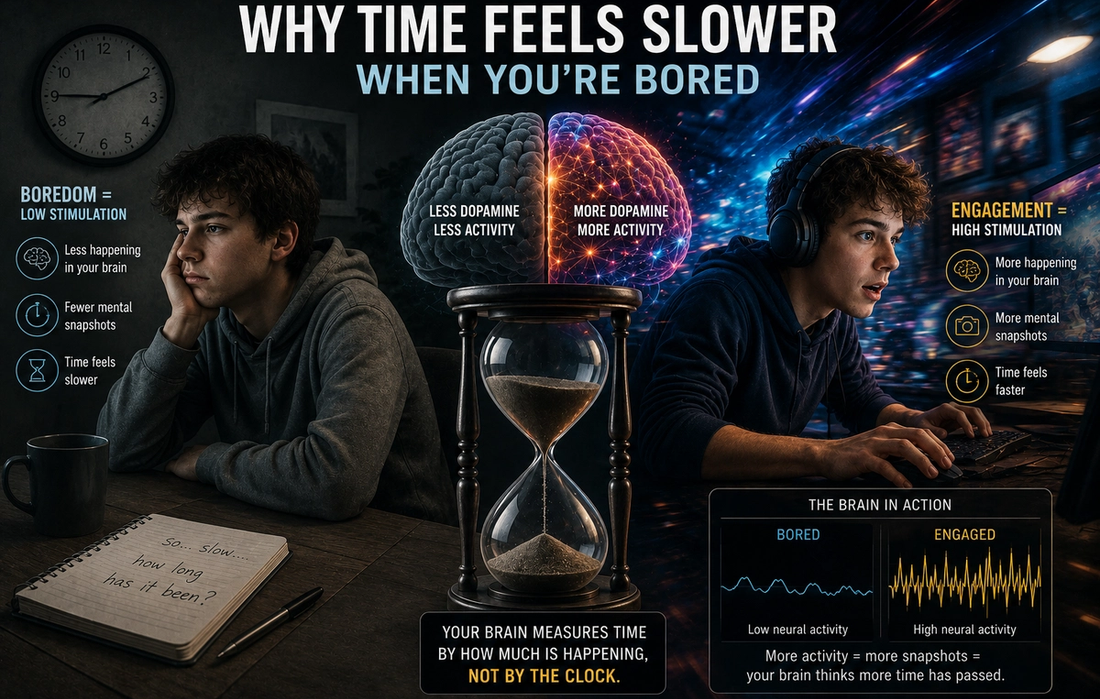
One major reason time feels slower during boring moments is because the brain has very little stimulation to focus on.
When people are engaged in interesting activities, attention moves naturally toward tasks, emotions, conversations, or experiences. The brain becomes absorbed.
During boredom, the opposite happens.
Instead of focusing outward, people become more aware of:
- waiting
- silence
- repetition
- discomfort
- the passage of time itself
The brain essentially starts monitoring time more closely, which creates the feeling that minutes are stretching longer than usual.
Attention Changes How Time Feels
Time perception is heavily connected to attention.
Psychologists often compare it to watching a clock. The more someone stares at the clock, the slower time seems to move.
That is why:
- waiting rooms feel endless
- traffic jams feel unbearable
- boring lectures seem longer than they are
The brain notices each passing moment more consciously.
By contrast, engaging activities reduce awareness of time because attention becomes focused elsewhere.
This is sometimes called “flow state” — the feeling of becoming so immersed in something that time almost disappears temporarily.
Novel Experiences Affect Time Differently
Interestingly, new experiences can make time feel faster in the moment but longer in memory afterward.
For example, vacations often seem to fly by while they are happening. But later, they feel long and detailed when remembered because the brain stored many unique experiences.
Routine works differently.
When life becomes repetitive, the brain stores fewer distinct memories. Days blur together more easily, making long periods of time feel strangely compressed in retrospect.
This is one reason childhood often feels longer emotionally than adulthood: children constantly experience new things.
The Brain Does Not Actually “Measure” Time Perfectly
Humans do not have an internal clock measuring time precisely like a stopwatch.
Instead, the brain estimates time based on:
- attention
- emotions
- memory
- sensory input
- mental engagement
Stress, fear, excitement, and boredom all distort time perception differently.
For example:
- frightening moments may feel slow and intense
- enjoyable conversations may feel surprisingly short
- repetitive routines may disappear from memory quickly
Time perception is deeply psychological.
Digital Life Changed How People Experience Time
Modern technology also affects time perception heavily.
Social media, short videos, constant notifications, and endless scrolling create environments filled with rapid stimulation. Hours can disappear surprisingly quickly online because attention stays continuously occupied.
At the same time, digital overstimulation may also make ordinary offline moments feel slower by comparison.
Many people now struggle more with boredom because modern technology trains brains to expect constant entertainment and novelty.
Silence and inactivity feel more uncomfortable than they once did.
Why Waiting Feels So Uncomfortable
Humans dislike uncertainty, which is why waiting often feels emotionally draining.
When people do not know exactly how long something will take, time tends to feel slower. Airports, customer service calls, loading screens, and traffic all create frustration partly because uncertainty increases awareness of passing time.
Interestingly, distractions can reduce this effect significantly.
That is why phones became so important during waiting moments. Even brief entertainment helps shift attention away from monitoring time directly.
Getting Older Changes Time Perception Too
Many adults feel like time speeds up as they age.
Part of this may happen because routines become more repetitive over time. Childhood contains many “first experiences,” while adulthood often becomes more structured and familiar.
The brain forms stronger memories around novelty, which makes earlier life periods feel richer and longer in hindsight.
As routines increase, years may start blending together more quickly emotionally.
The Feeling of Time Is Partly an Illusion
One fascinating thing about time perception is how subjective it really is.
Two people can experience the same amount of clock time completely differently depending on:
- mood
- attention
- environment
- stress levels
- emotional engagement
The brain constantly reshapes time internally without people realizing it.
In many ways, humans do not experience time directly — they experience their mind’s interpretation of it.
Boredom Reveals Something Important
Although boredom feels unpleasant, it also reveals how deeply human experience depends on attention and meaning.
Time slows down when the brain lacks stimulation because humans naturally seek engagement, curiosity, and emotional connection to the world around them.
Perhaps that is why meaningful experiences feel timeless while empty ones feel endless.
The clock may move at the same speed regardless of what happens, but the human mind rarely experiences it that way.