
The Real Reason Half-Life 3 Will (Probably) Never Exist

By Kate Willis on May 18, 2026
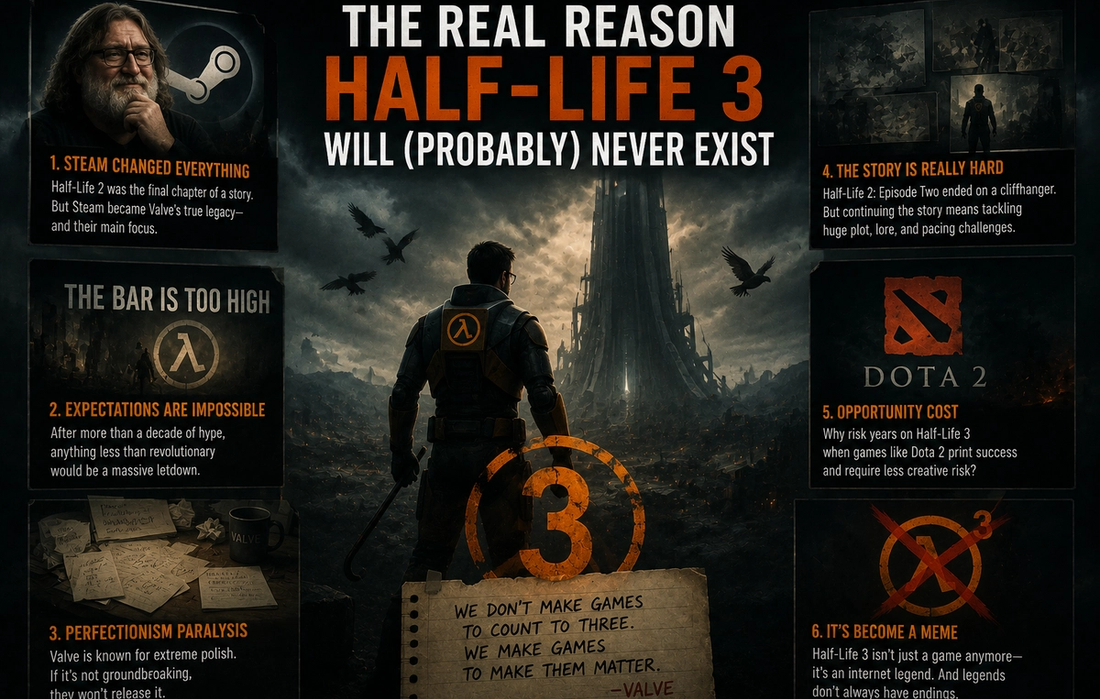
Few unreleased games became as legendary as Half-Life 3.
At this point, the game is less of a normal sequel and more of an internet myth. For nearly two decades, fans searched for clues, analyzed interviews, decoded rumors, and convinced themselves repeatedly that Valve was secretly preparing an announcement.
And every time, nothing happened.
The strange thing is that Half-Life 3 is not simply delayed anymore. It became one of gaming’s most famous examples of impossible expectations — a game so anticipated that releasing it may actually be harder than never making it at all.
Key Takeaways
- Half-Life 3 became one of gaming’s biggest unfinished legends
- Valve’s company culture plays a major role in the game’s absence
- Fan expectations grew almost impossible to satisfy
- The success of Steam changed Valve’s priorities completely
- The game’s myth may now be bigger than any actual sequel
Why People Cared So Much About Half-Life
When Half-Life released in 1998, it changed first-person shooters completely.
The game blended:
- cinematic storytelling
- immersive world-building
- advanced physics
- environmental narrative
- seamless gameplay
Then Half-Life 2 arrived in 2004 and pushed gaming even further forward technologically. Its physics engine, atmosphere, and storytelling became massively influential.
But the real problem started with the ending.
Valve released smaller follow-up episodes instead of a full sequel, and Episode Two ended on a huge cliffhanger in 2007.
Fans expected a continuation quickly.
It never came.
Valve Changed as a Company
One of the biggest reasons Half-Life 3 likely never happened is that Valve itself changed dramatically.
In the early 2000s, Valve was primarily a game developer. Today, Valve is also the company behind Steam — the largest PC gaming platform in the world.
Steam became unbelievably successful.
At that point, Valve no longer depended financially on releasing major games constantly. The company began operating differently from traditional publishers because it already generated enormous revenue through the platform itself.
That changed priorities internally.
Valve’s Internal Culture Makes Sequels Difficult
Valve is famous for having an unusual company structure.
Employees often move freely between projects rather than following strict top-down management. While this system encourages creativity, it can also make large long-term projects difficult to maintain.
Several reports over the years suggested that various versions of Half-Life 3 may have entered development and later been abandoned internally.
Part of the problem is simple: making a normal sequel was never enough.
Every major Half-Life game pushed technology and storytelling forward dramatically. Valve reportedly wanted any new entry to feel equally revolutionary.
That becomes harder over time as expectations grow.
The Expectations Became Impossible
At this point, Half-Life 3 may be trapped by its own legend.
Fans waited so long that the game transformed into something almost mythical. No realistic sequel could fully match the years of speculation people built around it.
Every rumor increased expectations further.
Players now expect:
- revolutionary gameplay
- groundbreaking technology
- perfect storytelling
- a satisfying conclusion to decades of buildup
That level of anticipation creates enormous pressure.
Releasing the game risks disappointing millions of fans who imagined their own perfect version for years.
Internet Culture Turned It Into a Meme
Over time, Half-Life 3 stopped being just a missing sequel and became one of the internet’s biggest running jokes.
“Half-Life 3 confirmed” became a meme anytime:
- Valve made announcements
- random numbers appeared
- developers hinted vaguely at projects
- fans discovered tiny “clues”
The game evolved into cultural mythology.
Entire generations of gamers grew up hearing about Half-Life 3 without ever expecting it to actually release.
Valve Did Return to Half-Life — Sort Of
In 2020, Valve surprised everyone by releasing Half-Life: Alyx, a virtual reality game set within the same universe.
Critics loved it, and many fans viewed it as proof Valve still cared about the franchise creatively.
But even Alyx avoided becoming the long-awaited Half-Life 3 directly.
Instead, it almost reinforced the idea that Valve prefers experimenting with new technology rather than delivering traditional sequels.
Sometimes Legends Become Bigger Than Reality
There is also something emotionally powerful about unfinished stories.
Because Half-Life 3 never arrived, fans kept imagining what it could have been. The absence itself became part of gaming culture.
In some strange way, the mystery helped preserve the franchise’s legendary status.
A disappointing sequel could damage that mythology. An unreleased sequel keeps the imagination alive forever.
The Gaming Industry Changed Completely
The world that created Half-Life 2 no longer exists.
Gaming shifted toward:
- live-service games
- online multiplayer
- massive open worlds
- battle passes
- streaming culture
Single-player story-driven shooters still exist, but they no longer dominate gaming culture the way they once did.
Valve itself evolved alongside those industry changes.
Half-Life 3 Represents Something Bigger Than a Game
At this point, Half-Life 3 symbolizes more than a missing sequel.
It represents:
- unfinished internet nostalgia
- impossible expectations
- changing gaming culture
- the mystery of creative ambition
For many fans, the game became a symbol of a different era of gaming entirely — a time when revolutionary single-player experiences felt capable of changing the industry overnight.
And perhaps that is the real reason Half-Life 3 feels so important even after all these years.
Not because people simply want another game, but because they want to recapture the feeling of what gaming once felt like when the future still seemed unpredictable.