
The Difference Between Narrow AI and General AI, Explained Simply

By Kate Willis on May 17, 2026
Artificial intelligence is one of the most talked-about technologies in the world right now. But despite how often people discuss AI, many still confuse two very different concepts: narrow AI and general AI.
The distinction matters because most AI people interact with today is far less advanced than science fiction often suggests.
Current AI systems can perform impressive tasks, but they are still highly specialized. Truly human-like artificial intelligence — often called general AI — does not actually exist yet.
Understanding the difference helps separate reality from hype.
Key Takeaways
- Most modern AI is considered narrow AI
- Narrow AI is designed for specific tasks only
- General AI would be capable of human-like reasoning across many areas
- Chatbots, recommendation systems, and image generators are examples of narrow AI
- General AI remains theoretical for now
What Narrow AI Actually Means
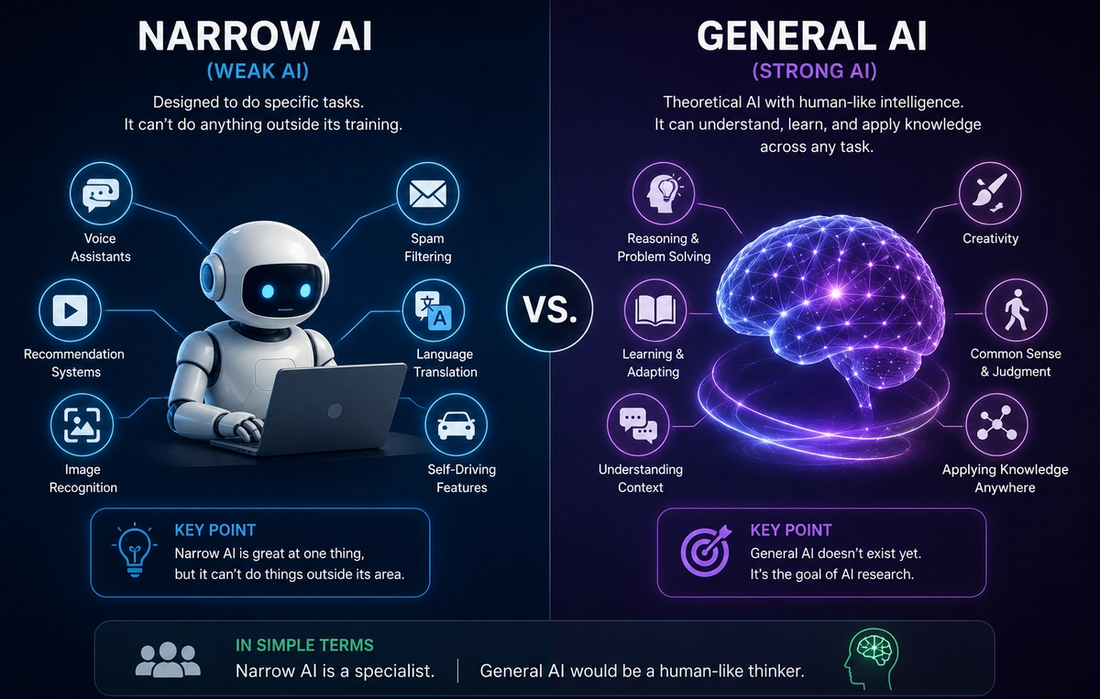
Narrow AI, sometimes called weak AI, is artificial intelligence built to perform a specific task or solve a limited problem.
These systems can appear extremely intelligent within their specialized area, but they cannot think beyond it.
For example:
- Netflix recommendations
- Voice assistants like Siri or Alexa
- Spam filters
- Face recognition systems
- AI image generators
- Navigation apps
All of these tools are forms of narrow AI.
A chess-playing AI may defeat world champions, but it cannot drive a car, write a novel, or understand emotions outside its programming and training.
That is the key limitation: narrow AI excels in one area but lacks broader understanding.
Why Narrow AI Feels So Impressive
Modern narrow AI has become incredibly advanced because machine learning systems can process enormous amounts of data very quickly.
AI tools now generate realistic images, answer questions, translate languages, and even mimic human conversation. This often creates the impression that machines truly “understand” the world.
But narrow AI does not think the way humans do.
Instead, it identifies patterns from training data and predicts the most likely response or action. It may sound intelligent, but it does not possess awareness, emotions, or genuine comprehension.
In many ways, narrow AI is highly sophisticated pattern recognition.
What General AI Would Be
General AI, often called AGI (Artificial General Intelligence), is the idea of a machine capable of human-level thinking across many different areas.
Unlike narrow AI, a general AI system would not be limited to one task.
A true AGI could theoretically:
- Learn new skills independently
- Reason across unrelated topics
- Solve unfamiliar problems
- Adapt to new environments
- Understand context more deeply
- Transfer knowledge between tasks
Essentially, it would behave more like a human mind rather than a specialized tool.
A person who learns mathematics can also learn music, cooking, or driving. Narrow AI systems usually cannot transfer abilities that way.
General AI would represent a major leap beyond current technology.
Why General AI Does Not Exist Yet
Despite rapid AI progress, researchers still face enormous challenges in creating general intelligence.
Human intelligence is far more complex than many people realize. Humans combine logic, memory, emotion, creativity, intuition, and social understanding in ways machines still struggle to replicate.
Current AI systems also lack true common sense.
For example, an AI chatbot may generate convincing answers while still misunderstanding simple real-world context. It predicts language patterns rather than genuinely understanding meaning the way humans do.
Researchers continue exploring AGI, but experts disagree on how close it actually is.
Some believe it could arrive within decades. Others think it may remain far away — or may never fully happen at all.
Why the Confusion Happens
Part of the confusion comes from how AI is portrayed online and in entertainment.
Movies often show robots becoming instantly self-aware or machines behaving exactly like humans. Meanwhile, modern AI tools can already perform tasks that once seemed impossible.
This creates the illusion that today’s systems are closer to human intelligence than they really are.
In reality, most current AI remains narrow and task-specific, even when it feels surprisingly capable.
An AI model that writes essays cannot automatically understand physics, emotions, ethics, or personal experiences the way humans naturally do.
Could General AI Change Everything?
If true general AI were ever achieved, the impact could be enormous.
Some experts believe AGI could transform medicine, science, education, engineering, and nearly every major industry. Others warn about serious ethical and societal risks if such systems became too powerful or poorly controlled.
Because AGI does not yet exist, many discussions remain theoretical.
Still, the possibility continues to drive major investment and research around the world.
Most AI Today Is Still Just a Tool
For now, it is important to remember that modern AI systems are tools — extremely advanced tools, but still tools.
They can automate tasks, analyze information, generate content, and assist humans in remarkable ways. But they are not conscious machines secretly thinking like humans behind the screen.
The difference between narrow AI and general AI is ultimately the difference between specialization and true adaptability.
And while narrow AI is already reshaping everyday life, genuine human-like artificial intelligence remains something the world has not yet created.