

How Black Holes Work (Without the Math)

By Kate Willis on May 18, 2026
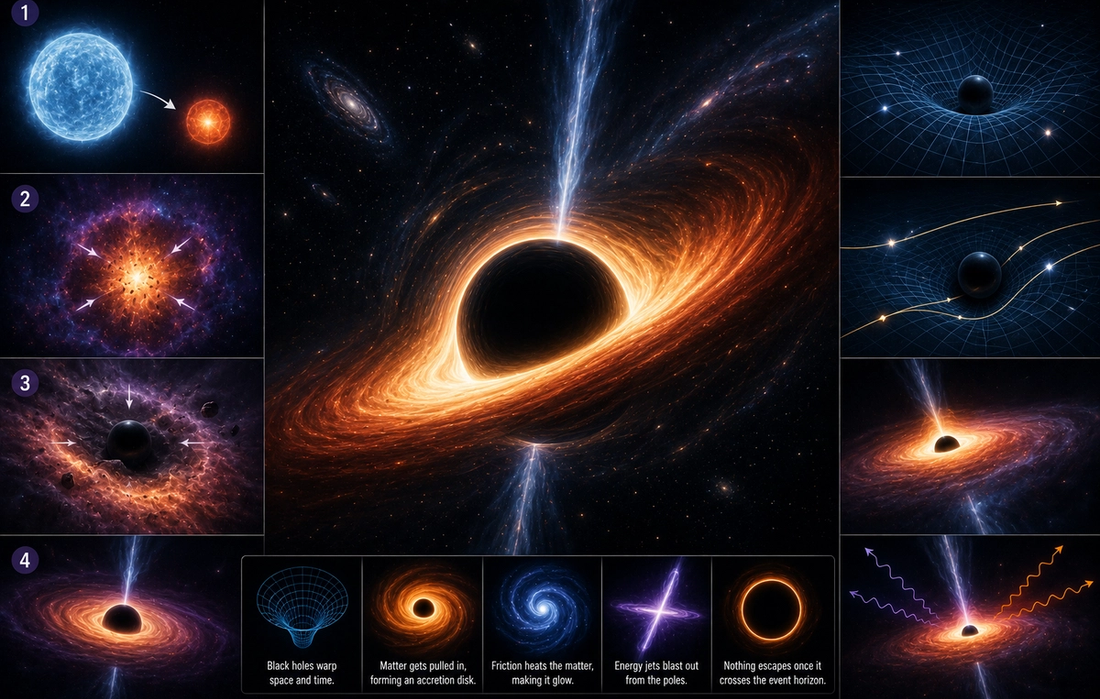
Black holes are some of the strangest objects in the universe.
They swallow light, bend space itself, and seem to break many of the rules people normally associate with reality. For decades, black holes existed mostly as scientific theories and science fiction concepts. Today, scientists know they are very real — and even managed to photograph one for the first time.
Despite how mysterious they sound, the basic idea behind black holes is actually easier to understand than many people think.
You do not need advanced physics or complicated equations to grasp why they are so fascinating.
Key Takeaways
- Black holes form when massive stars collapse
- Their gravity becomes so strong that even light cannot escape
- Black holes do not “suck” everything in like cosmic vacuum cleaners
- Time and space behave strangely near them
- Scientists still do not fully understand what happens inside them
What a Black Hole Actually Is
A black hole is a region in space where gravity becomes incredibly powerful.
Normally, stars balance two forces:
- gravity pulling inward
- energy from nuclear reactions pushing outward
But when a very massive star runs out of fuel, gravity wins. The star collapses inward under its own weight so intensely that it compresses into an extremely tiny space.
That collapse creates a black hole.
The object becomes so dense that its gravitational pull grows enormous.
Why Black Holes Look “Black”
Black holes are called black because nothing can escape once it gets too close — not even light.
Normally, humans see objects because light reflects off them. But inside a black hole’s boundary, called the event horizon, gravity becomes too strong for light itself to escape.
Without escaping light, the black hole appears completely dark.
That does not mean black holes are invisible, though.
Scientists often detect them by observing how nearby stars, gas, and light behave around them.
They Are Not Giant Cosmic Vacuum Cleaners
Movies often make black holes seem like giant monsters sucking in entire galaxies constantly.
In reality, black holes behave more like any other object with gravity.
If the sun suddenly became a black hole with the same mass, Earth would continue orbiting normally. The planet would not instantly get pulled inward.
What makes black holes dangerous is getting extremely close to them.
Near the event horizon, gravity changes dramatically over short distances, creating intense tidal forces.
Time Gets Weird Near Black Holes
One of the strangest things about black holes is how they affect time itself.
According to Einstein’s theory of relativity, stronger gravity slows down time.
Near a black hole, this effect becomes extreme.
If someone observed a person approaching a black hole from far away, the falling person would appear to move slower and slower over time. Near the event horizon, they would seem almost frozen.
For the person falling inward, however, time would feel relatively normal.
Black holes reveal that time is not fixed the way humans usually imagine it.
What Happens If Something Falls In?
This is where things become deeply mysterious.
Once something crosses the event horizon, it cannot escape again. Scientists believe matter continues collapsing toward an infinitely dense point called a singularity.
But singularities create huge problems in physics because current scientific theories stop working properly there.
In simple terms: scientists still do not fully know what truly happens inside a black hole.
That mystery makes black holes one of the biggest unsolved puzzles in modern science.
Supermassive Black Holes Exist in Most Galaxies
Some black holes are far larger than others.
Small black holes may form from collapsed stars, but supermassive black holes contain millions or even billions of times the mass of the sun.
Scientists now believe enormous black holes exist at the center of most galaxies — including the Milky Way.
The supermassive black hole at the center of our galaxy is called Sagittarius A*.
Despite their frightening reputation, these giant black holes actually help shape how galaxies form and evolve.
Scientists Finally Photographed One
For a long time, black holes seemed impossible to photograph directly because they emit no light.
That changed in 2019 when scientists released the first real image of a black hole using the Event Horizon Telescope project.
The image showed a glowing ring surrounding a dark center — the shadow of a black hole located millions of light-years away.
To create the picture, researchers connected telescopes across Earth to function like one giant planet-sized telescope.
It became one of the most important scientific achievements of the modern era.
Black Holes Continue Challenging Physics
Black holes are fascinating partly because they expose gaps in human understanding.
Modern physics works extremely well in most situations, but black holes push theories to their limits. Scientists still struggle to fully combine:
- gravity
- quantum mechanics
- spacetime behavior
- singularities
Some researchers believe understanding black holes better could eventually lead to entirely new discoveries about how the universe works.
The Universe Is Stranger Than Humans Expected
One reason black holes capture human imagination so strongly is because they feel almost impossible.
Objects that trap light, distort time, and bend space itself sound more like fantasy than reality. Yet black holes genuinely exist all across the universe.
And perhaps the strangest part is this: the more scientists learn about black holes, the more mysterious they seem to become.
They are reminders that even with all modern technology and scientific progress, the universe still contains things humans barely understand at all.