5 Things Scientists Used to Believe That Are Now Totally Wrong

By Kate Willis on May 18, 2026
Science is built around questioning ideas, testing evidence, and changing conclusions when new discoveries appear. That process is exactly what makes science powerful — but it also means that many things once considered absolutely true later turn out to be completely wrong.
Looking back at older scientific beliefs can feel strange, funny, and sometimes even shocking. Some ideas now seem absurd, while others reveal how limited human understanding once was.
But future generations may eventually look at some modern beliefs the same way.
Key Takeaways
- Science constantly evolves as new evidence appears
- Many older scientific theories once seemed completely logical
- Some outdated ideas influenced medicine, astronomy, and biology for centuries
- Scientific mistakes often led to better discoveries later
- Being wrong is actually part of how science progresses
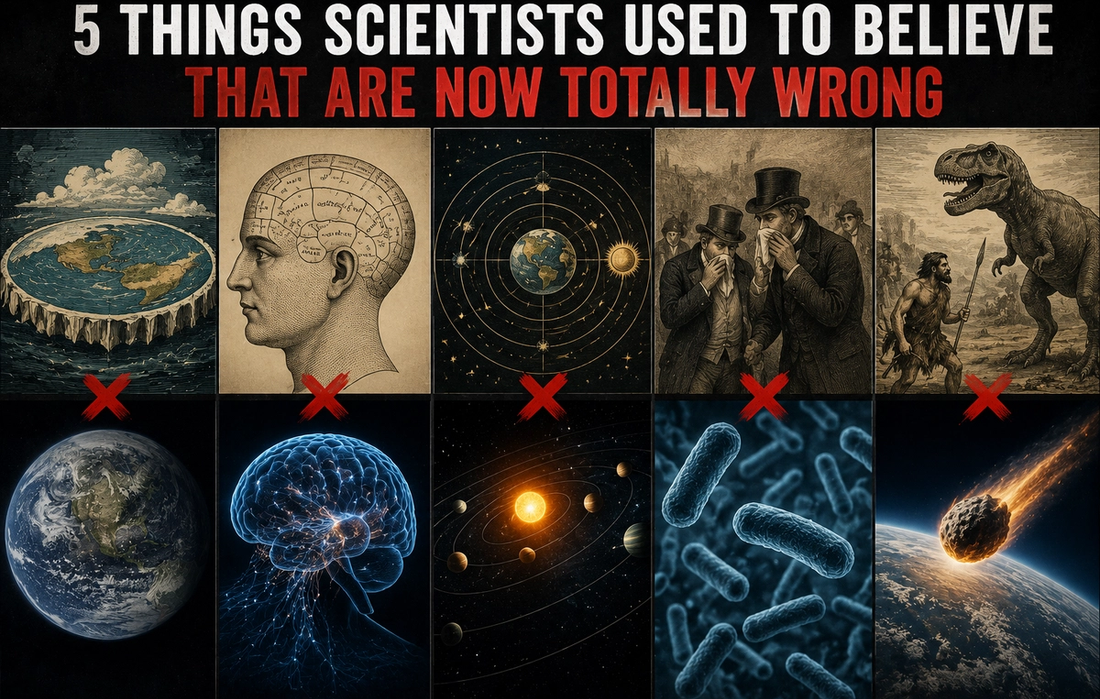
1. People Once Believed the Earth Was the Center of the Universe
For centuries, many scientists and philosophers believed Earth sat at the center of the universe while everything else revolved around it.
This idea, called the geocentric model, dominated astronomy for a very long time because it matched everyday observation. After all, the sun, moon, and stars appear to move across the sky while Earth feels still beneath our feet.
The model became deeply connected to religion, philosophy, and early science.
Then astronomers like Copernicus, Galileo, and Kepler helped prove something revolutionary: Earth actually orbits the sun.
The discovery completely changed humanity’s understanding of its place in the cosmos.
2. Doctors Used to Practice Bloodletting
One of the strangest chapters in medical history was the belief that removing blood could cure illness.
For hundreds of years, doctors believed health depended on balancing bodily “humors,” and bloodletting became a common treatment for everything from fever to headaches.
Patients were sometimes intentionally bled using knives or leeches in hopes of restoring balance.
In reality, bloodletting often weakened patients further and sometimes made illnesses worse.
Modern medicine eventually replaced these practices with evidence-based approaches built on biology, germs, and scientific testing.
3. Scientists Once Thought Continents Couldn’t Move
Today, plate tectonics is considered fundamental geology. Scientists understand that Earth’s continents slowly shift over time.
But when Alfred Wegener first proposed continental drift in the early 1900s, many experts rejected the idea completely.
The notion that entire continents moved across the planet sounded ridiculous to many scientists at the time.
Years later, better evidence finally confirmed that tectonic plates do move constantly beneath Earth’s surface.
Now plate tectonics explains:
- earthquakes
- mountain formation
- volcanic activity
- continental movement
An idea once mocked became one of the most important theories in Earth science.
4. People Believed Diseases Came From “Bad Air”
Before germ theory, many believed diseases spread through “miasma” — poisonous or unpleasant air.
Bad smells were thought to cause illness directly.
This belief was not entirely irrational because unsanitary places often did smell terrible. But scientists later discovered the real cause involved microscopic organisms like bacteria and viruses rather than odors themselves.
The development of germ theory transformed medicine completely:
- sanitation improved
- surgeries became safer
- vaccines advanced
- infection control became possible
It remains one of the biggest breakthroughs in human health history.
5. Scientists Once Thought Dinosaurs Were Slow and Clumsy
Early dinosaur reconstructions often portrayed them as giant sluggish reptiles dragging heavy tails across the ground.
Modern paleontology revealed something very different.
Many dinosaurs were:
- fast
- active
- intelligent
- bird-like
- highly adaptable
Some species even had feathers.
Today, scientists believe birds are actually direct descendants of certain dinosaurs, which means tiny dinosaurs still exist all around us.
The modern image of dinosaurs is far more dynamic and complex than older generations imagined.
Science Improves by Admitting Mistakes
One of the most important things about science is that it allows itself to change.
Unlike rigid belief systems, scientific understanding evolves when evidence improves. Being wrong is not considered failure — it is part of the process.
New discoveries constantly reshape knowledge about:
- space
- medicine
- evolution
- climate
- physics
- consciousness
Many ideas accepted today may eventually become outdated too.
Why Old Scientific Beliefs Still Matter
It is easy to laugh at older scientific mistakes now, but many past theories were based on the best information available at the time.
Human understanding always has limits.
Looking back at outdated beliefs reminds people to stay curious, skeptical, and open-minded about current knowledge too. Scientific progress depends on questioning assumptions continuously.
The Universe Is More Complicated Than Humans Expect
History repeatedly shows that reality tends to be stranger and more complex than humans initially assume.
Earth was not the center of the universe. Disease did not come from bad air. Dinosaurs were not giant lizards dragging through swamps.
Every generation thinks it understands the world fairly well — until new discoveries prove otherwise.
And that may be one of the most fascinating things about science itself: the more humanity learns, the more obvious it becomes how much still remains unknown.