

5 Animals That Defy What We Know About Biology

By Kate Willis on May 18, 2026
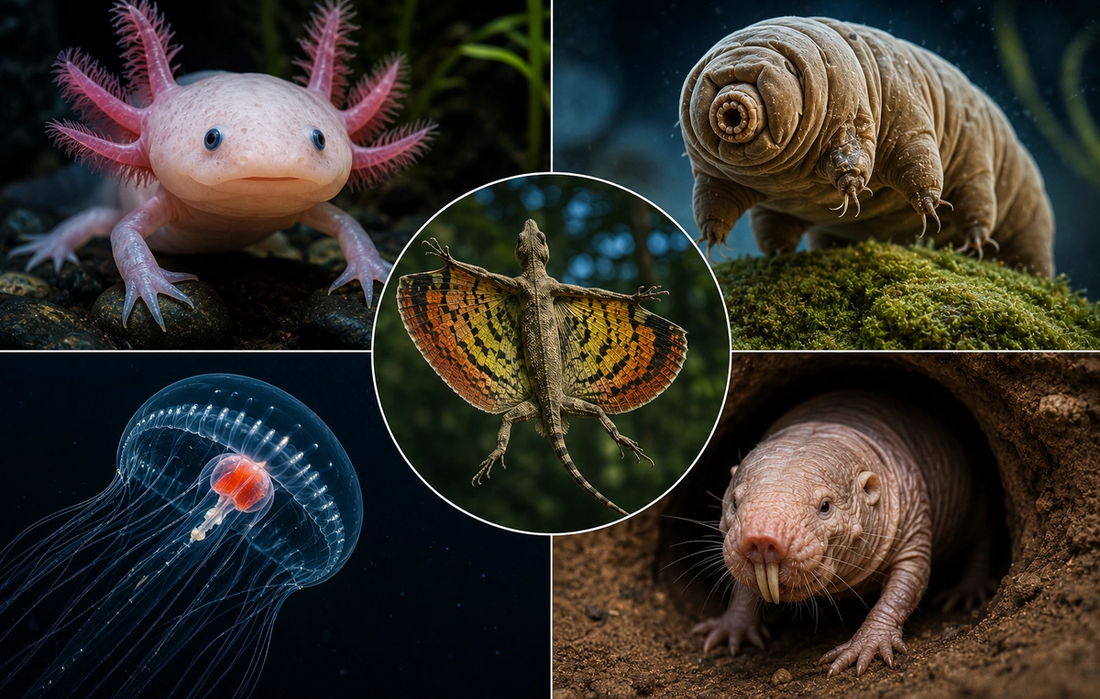
Nature is full of creatures so strange that they seem almost impossible.
Some animals survive conditions that should kill them instantly. Others regenerate body parts, change sex, clone themselves, or live far longer than scientists once thought biologically possible.
The more researchers study life on Earth, the more obvious it becomes that biology is far stranger and more flexible than humans originally imagined.
Certain animals do not just adapt to nature — they completely challenge scientific assumptions about how life is supposed to work.
Key Takeaways
- Some animals possess abilities that seem almost science fiction-like
- Evolution created survival mechanisms scientists still struggle to explain fully
- Extreme environments often produce the strangest biological adaptations
- Certain species challenge assumptions about aging, survival, and reproduction
- Nature continues revealing how little humans truly understand about life
1. The Immortal Jellyfish
The immortal jellyfish may be one of the strangest creatures on Earth.
Unlike most living organisms, this tiny jellyfish can essentially reverse its own aging process. When stressed, injured, or starving, it transforms back into an earlier stage of life instead of dying normally.
In theory, this process could repeat indefinitely.
Scientists call this biological transdifferentiation, where mature cells convert into younger forms again.
Of course, immortal jellyfish can still die from predators or disease. But biologically, they challenge the normal idea that aging must always move in one direction.
2. Tardigrades Can Survive Almost Anything
Tardigrades, also called water bears, are microscopic creatures famous for being nearly indestructible.
These tiny animals survived:
- extreme heat
- freezing temperatures
- radiation
- dehydration
- crushing pressure
- even the vacuum of space
When conditions become dangerous, tardigrades enter a dormant state where their metabolism nearly stops completely.
Scientists remain fascinated by how resilient they are because understanding tardigrades could influence:
- medicine
- space travel
- cryogenics
- biotechnology
They look tiny and harmless, but biologically they are astonishing.
3. Octopuses Seem Almost Alien
Octopuses are so intelligent and biologically unusual that some scientists jokingly describe them as “alien-like.”
Unlike most animals, octopuses:
- have three hearts
- blue blood
- highly flexible bodies
- advanced problem-solving skills
- decentralized nervous systems
Much of their nervous system exists inside their arms, meaning each limb can operate semi-independently.
They solve puzzles, escape containers, recognize humans, and display behaviors that suggest remarkable intelligence.
Some researchers believe octopus cognition evolved along a completely different path from vertebrate intelligence, making them one of Earth’s most unique minds.
4. Axolotls Can Regrow Body Parts
Axolotls are amphibians with one extraordinary ability: they can regenerate major body parts repeatedly.
Unlike humans, axolotls can regrow:
- limbs
- spinal cord tissue
- parts of the brain
- heart tissue
And they often do this without scarring.
Scientists study axolotls intensely because understanding their regenerative abilities could eventually influence human medicine and injury treatment.
The animal almost feels like a biological glitch in evolution.
5. The Pistol Shrimp Creates Shockwaves With Its Claw
The pistol shrimp is tiny, but its claw produces one of the most powerful biological attacks in nature.
When snapping its specialized claw shut, the shrimp creates a collapsing bubble that generates:
- extreme heat
- intense pressure
- powerful shockwaves
- tiny flashes of light
The temperature inside the bubble briefly approaches the surface temperature of the sun.
This process, called cavitation, is so powerful that it can stun or kill nearby prey instantly.
For such a small animal, the physics involved are almost unbelievable.
Evolution Produces Stranger Solutions Than Fiction
One reason these animals fascinate scientists is because they reveal how creative evolution can become over millions of years.
Nature does not follow human expectations about what life “should” look like.
Instead, organisms adapt in bizarre ways depending on:
- environment
- survival pressure
- competition
- climate
- chance mutations
The result is a planet filled with creatures that often sound fictional until people realize they are completely real.
Many Biological Mysteries Remain Unsolved
Despite huge scientific advances, researchers still do not fully understand many extreme biological abilities.
Questions remain about:
- regeneration
- aging
- intelligence
- survival under extreme conditions
- evolutionary adaptation
Some discoveries may eventually reshape medicine, genetics, or even human longevity research.
The more scientists study life, the more complex it appears.
Nature Is Still More Advanced Than Human Technology
Humans build advanced machines, AI systems, and cutting-edge technology, yet nature still performs feats scientists struggle to replicate artificially.
Animals evolved solutions over millions of years that:
- heal efficiently
- survive harsh environments
- process information differently
- adapt dynamically
In many ways, biology remains one of the most advanced technologies on Earth.
The Planet Is Full of Things Humans Barely Understand
One of the most humbling parts of science is realizing how much remains mysterious.
Entire ecosystems, species, and biological processes still challenge modern understanding regularly. Creatures like immortal jellyfish or nearly indestructible tardigrades remind people that life evolved in ways far stranger than human imagination often predicts.
And perhaps the most incredible part is this: some of the weirdest things in existence are not hidden in distant galaxies or science fiction stories.
They are already alive here on Earth.